Your child isn't lazy.
They're just forgetting.
Every parent has watched it happen. They revise a topic in October, swear they know it, and by the mock in February it's gone. That isn't a discipline problem — it's how memory works. So we built the tutoring around it.
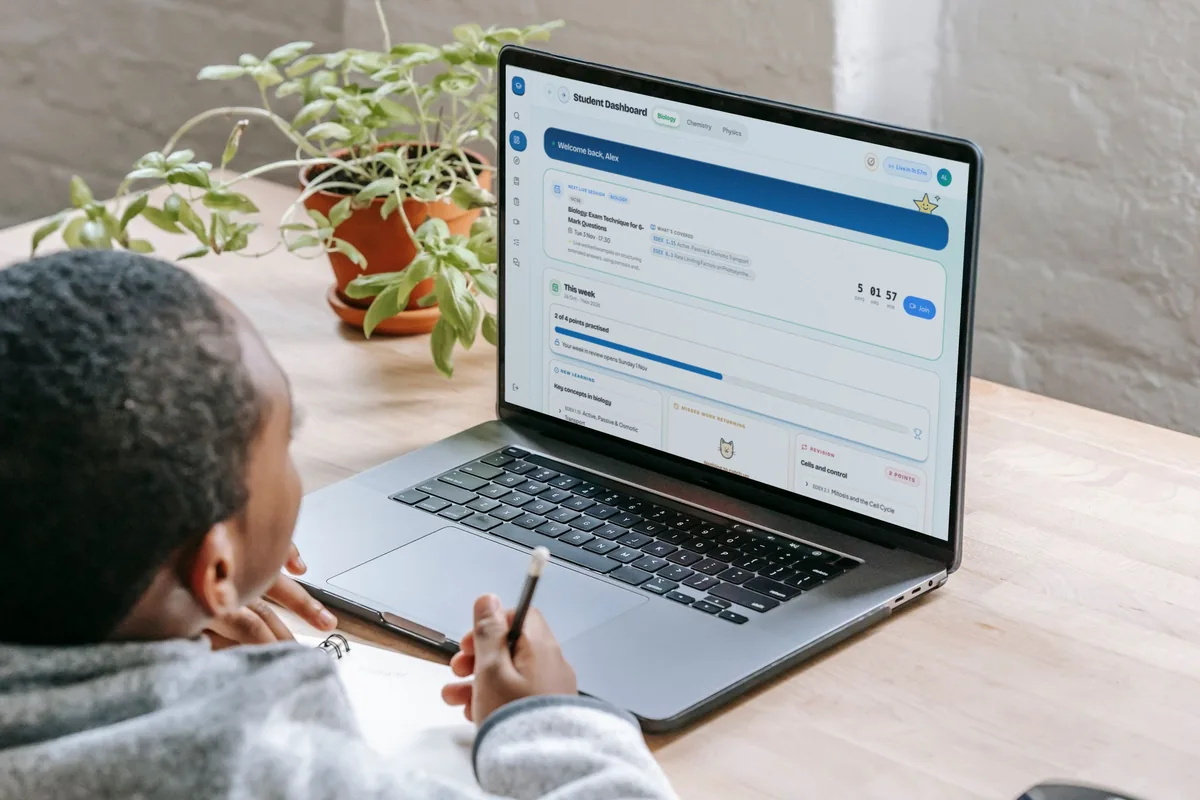
Planned around your child, taught live and marked by Dr Nadia and Ali
Planned
A course planned around your child
We lay out the whole course on your child's exam board, from the week they join to their exam date. Each week shows what to learn, and which topics to revisit.
- Set to their exam board, level and exam date
- Weak topics come back, based on their marked tasks and quizzes
- Reviewed and adjusted by Dr Nadia or Ali every week
Taught live
Up to 3 live sessions a week
Small groups on Zoom, taught personally by Dr Nadia or Ali — a doctor and a medical student, never an agency tutor and never a recording standing in for a lesson. Your child is a name in the room, not a login.
- Taught against your child's own exam board and spec points
- Every session recorded, so a missed week is recoverable
- Groups kept small enough that a quiet student can't hide
Practised
Tasks set, marked and returned
Answered inside the platform on the spec points just taught, then marked by the tutor who taught them — so the feedback comes from someone who watched your child try it, not a marking service.
- Returned with a grade, a percentage and personalised comments
- Written feedback that says what to do differently, not just what was wrong
- The mark feeds the schedule automatically — nothing to chase
Tested
A weekly quiz on the right topics
Every week, a short quiz built from the spec points your child has actually covered — tutor-approved, tagged question by question, and marked the moment they finish.
- Every question tagged to a specific spec point
- Instant explanations, so a wrong answer teaches something
- Scores feed straight into what comes back next week
Fed back
A tutor who tells you what they're seeing
Not a termly report. Each week your child gets a note from their tutor about their week specifically — what has clicked, what is still leaking marks, and what the two of them are doing about it next.
- Written by the tutor, about your child, every week
- Points at named spec points, not vague encouragement
- Visible to you in the parent dashboard as it happens
Never stuck
A direct line to their tutor, all week
Stuck at nine on a Sunday? They message their tutor from inside the platform, with the spec point, task or quiz question already attached — so the answer that comes back is about the thing they're actually stuck on.
- Questions pinned to the exact topic they came from
- Answered by their tutor — never auto-replied by a bot
- No app to install, no phone number to share
A predicted grade that means something
Built from real marked work over time, not a one-off test. It moves when their work moves.
Your own parent dashboard
A separate login: attendance, submissions, scores and progress — without having to ask them how it's going.
Every board, every spec point
AQA, Edexcel and OCR, Separate Sciences or Combined Trilogy — and iGCSE. Tagged to the specification your child is sitting.
Flexibility that suits you
Weekly, monthly or termly billing. Add or drop subjects as things change. Cancel anytime.
Try the scheduler
Play the part of your child for a moment. Answer a quiz, and watch the plan react in real time, using the same memory and weekly eligibility rules.
This week's quiz
Osmosis in plant cells
Say your child has just sat the weekly quiz on this topic. How did it go?
What the planner does
Pick an outcome to see this point's earliest weekly review slot. Your child's actual assignment also depends on the exam date and any saved weekly plan.
Most of a lesson is gone within a month
Memory fades on a predictable curve — and because it's predictable, it can be beaten. Bring a topic back just before it slips, and each time it sticks for longer. This is the same principle medical students use to hold thousands of facts through finals.
Same lesson, same student — the only difference is whether anything brought the topic back. By exam term one has held 97% of what they learned, the other roughly 54%. And it took just 3 short revisits to get there.
Give them a system, not just a tutor
Small groups, a doctor and a medical student teaching every lesson personally, and a plan that keeps working between them.